Free shipping for orders over 499 riyal


Quick answer: Compressor oil circulates with the refrigerant inside the A/C system and protects the compressor from wear. Most Japanese and Korean cars use PAG 46, while some American and European cars use PAG 100 or PAG 150. The correct grade is usually printed on the A/C label under the hood or in the owner's manual. Hybrids with electric compressors never use PAG.
Why does the compressor need oil?
The compressor is the heart of the A/C: it pressurises the refrigerant and pumps it around the system. Its moving parts need lubrication, and the oil mixes with the refrigerant and travels with it. When there is a refrigerant leak, some oil escapes too, and a compressor running low on oil overheats and wears out, which is an expensive repair.
What do the numbers in PAG 46, 100 and 150 mean?
PAG stands for Polyalkylene Glycol, a synthetic oil made for R134a and R1234yf refrigerants. The number is the viscosity: the higher the number, the thicker the oil.
| Type | Viscosity | Commonly used in |
| PAG 46 | Light | Most Toyota, Nissan, Honda, Hyundai, Kia and Mazda models |
| PAG 100 | Medium | Some GM, Ford and Chrysler vehicles and some European cars |
| PAG 150 | Heavy | Some trucks and older or larger GM and Ford vehicles |
| POE (e.g. ND-11) | Special | Hybrids and EVs with electric compressors |

BG Avalanche PAG46 synthetic compressor oil 236 ml
The table is a general guide; your A/C label or owner's manual is the final reference.
Warning: hybrid cars
The electric compressor in hybrids (such as Camry, Corolla and RAV4 Hybrid) has an electric motor inside and needs electrically insulating POE oil. Adding PAG, or refrigerant pre-mixed with PAG, can break down the insulation and destroy the compressor. Only have a hybrid A/C serviced by a shop that knows this.
When should you add compressor oil?
- When replacing the compressor, evaporator, condenser or drier, using the amount the manufacturer specifies for each part.
- After repairing a major leak that lost oil.
- A normal refrigerant top-up without a leak usually needs no extra oil; too much oil is as harmful as too little.
Common mistakes
- Mixing different PAG grades or mixing PAG with mineral oil.
- Leaving the bottle open: PAG absorbs moisture from the air quickly, so close it straight after use.
- Adding extra oil "just in case" without measuring, which reduces cooling and strains the compressor.
For refrigerant types and signs of low refrigerant, read: Car A/C refrigerant: signs of a leak and R134a vs R1234yf.
Recommended products from CarBoost
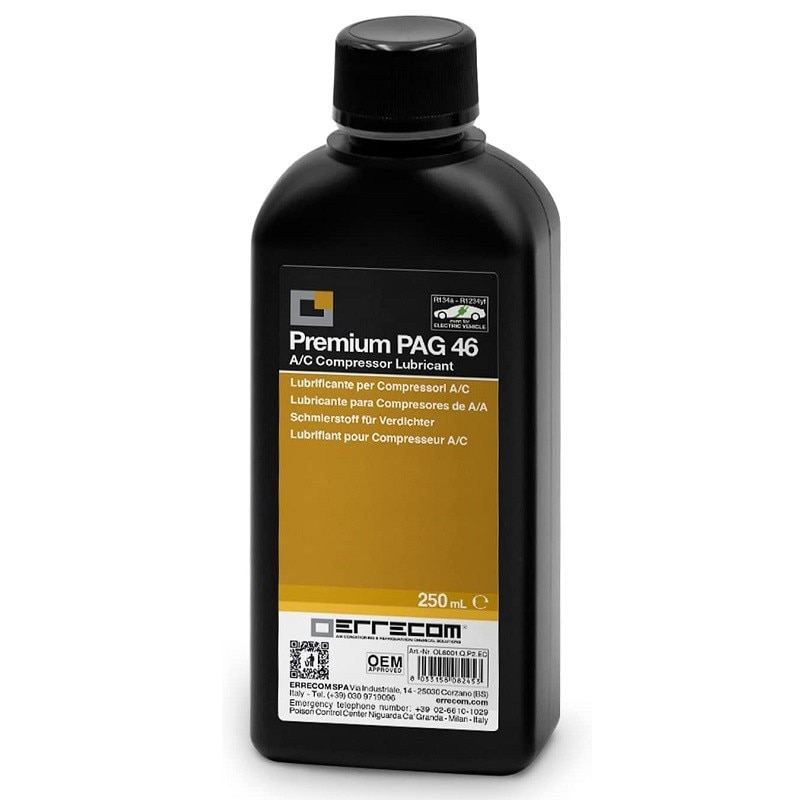
Errecom PAG 46 compressor oil 250 ml
- BG Avalanche PAG46 synthetic compressor oil 236 ml
- Errecom PAG 46 compressor oil 250 ml
- Avalanche PAG100 and PAG150 with UV leak-detection dye
- All compressor oils and A/C refrigerants
FAQ
Is compressor oil the same as A/C oil?
Yes, both names refer to the oil that circulates with the refrigerant inside the A/C system.
What is the UV dye in some oils for?
It glows under ultraviolet light, so the technician can find the leak easily.
How much oil does my car need?
It varies by car and is usually printed on the A/C label alongside the refrigerant charge. When replacing a single part, only that part's specified amount is added.
📲 Replacing your A/C compressor? Share this article with your technician first.
🔧 CarBoost is here to help: shop genuine compressor oils with delivery across Saudi Arabia and Tabby/Tamara instalments, or book fitting at the CarBoost service center in Jeddah.